
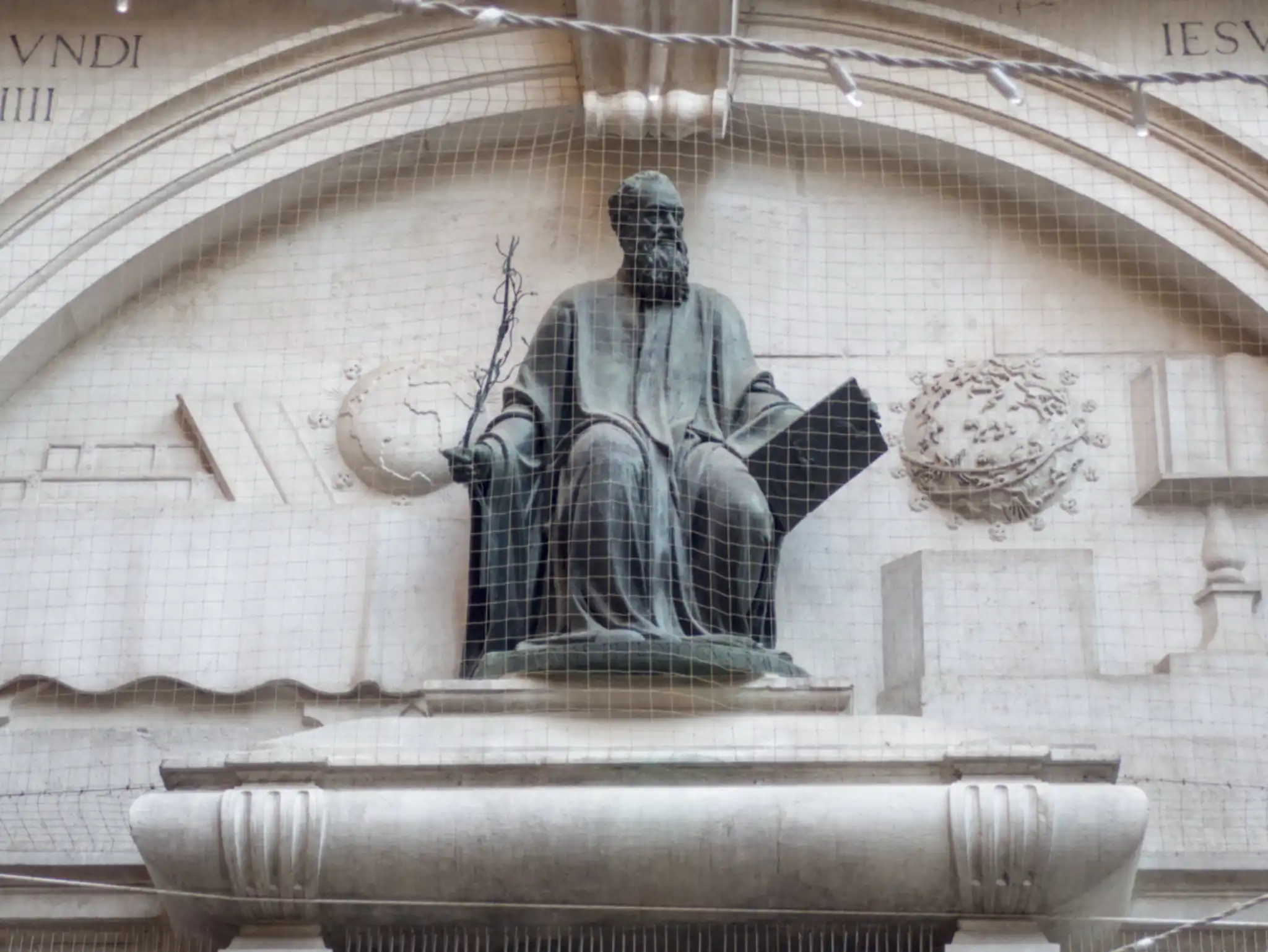
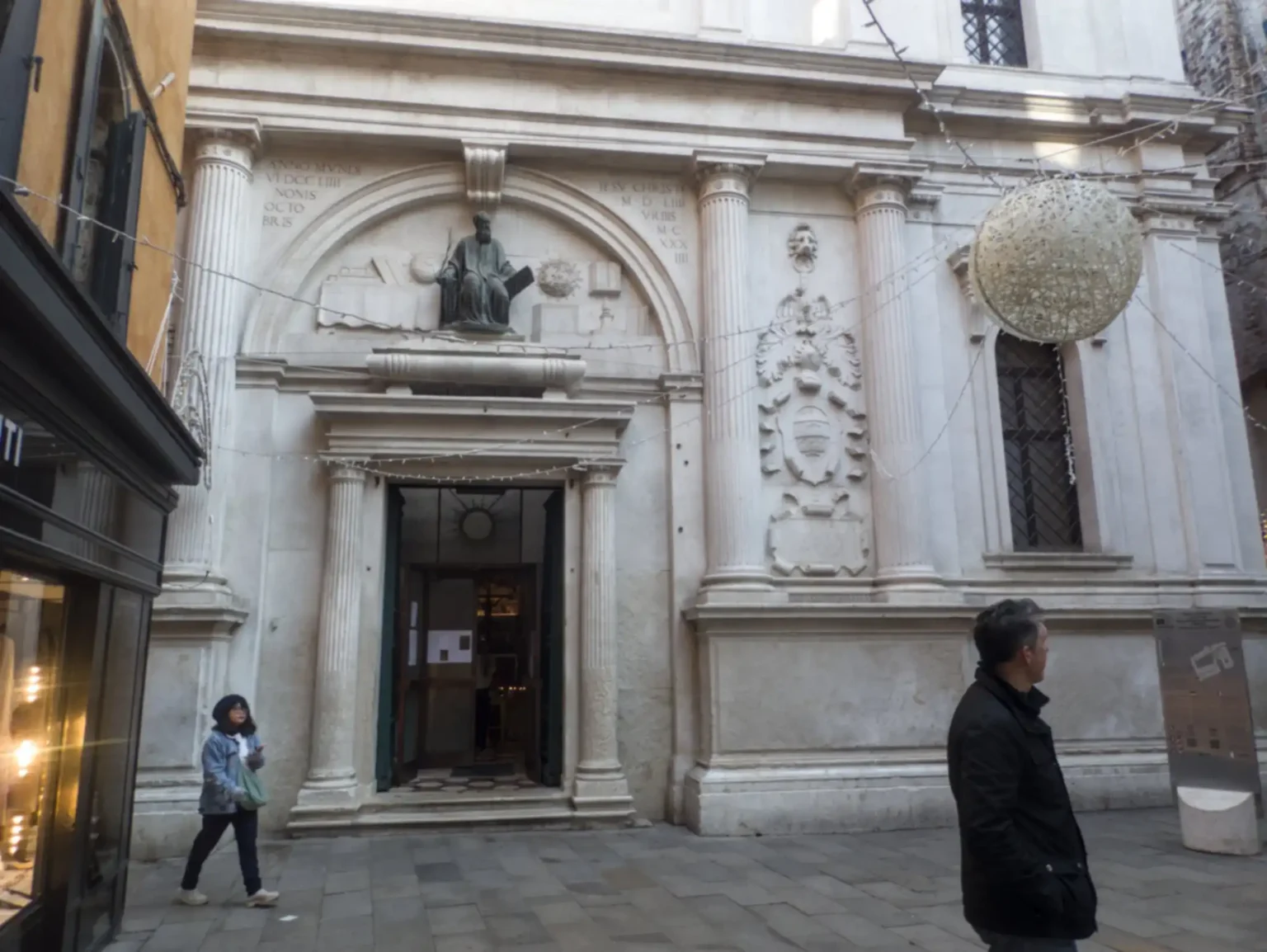
There’s a statue of a bearded man on the façade of the church of San Zulian, above the entrance.
Yet another saint, one presumes, before walking on towards the main sights at St Mark’s.
Well, no!
That’s Tommaso Ravenna, astrologer, physician, patron of the arts and sciences, knighted in several countries, who in the 1500s got rich and famous selling remedies to the rich for syphilis.
Tommaso Giannotti
The man, who in Venice styled himself Thomas Philologus Ravennas and who reached the highest levels of Venetian society possible for a non-Venetian non-noble, was born Tommaso Giannotti in Ravenna, in 1493.
Little is otherwise known about him before he appears at the University of Bologna. In 1513, he defended his dissertation, and soon afterwards he was teaching astrology, in a position reserved for brilliant but poor scholars.
This is where he acquired the academic title of Philologus, which he used for the rest of his life.
His relationship to Venice started, when he went to Rome, around 1516, under the patronage of Cardinal Domenico Grimani, of the Venetian noble family. This connection would later open many doors for the young Tommaso Giannotti from Ravenna.
After just a few years in Rome, he followed his patron back to Venice, and soon after he was given a teaching position at the University of Padua, initially sophism, but he quickly moved to astrology and mathematics.
Tommaso Rangoni
Another opportunity led to further changes, also of his name.
He left Padua for a position as astrologer and physician to Count Guido Rangoni, an aristocrat from the Duchy of Modena, a condottiere in the service of the Papal State.
Giannotti was one of the astrologers, who foresaw a giant flooding for 1524, due to a conjunction of several planets in the sign of Pisces. The flooding didn’t materialise, and Rangoni and Giannotti, who with many others had sought refuge in the mountains, were sorely ridiculed in the carnival in Modena that year.
Despite the flood debacle, Giannotti remained in the service of Rangoni until 1532, and their relationship was so close, that Rangoni gave Giannotti permission to use his surname. He signed himself as “Thoma Rangone” as early as 1527.
Military misfortune brought Count Rangoni to Venice, which he departed in 1532 for Hungary to fight the Ottoman Turks.
His astrologer and physician remained in Venice.
Tommaso Ravenna
In Venice, he was known as Tommaso Ravenna, from his place of birth.
He had published much over the years while in the service of Grimani and Rangoni, mostly on astrology and forecasts, but he gradually shifted towards medicine.
Once in Venice, he produced numerous booklets and pamphlets, on matters of medicine, and especially on syphilis and advice for longevity, both of which quite profitably.
As his writings circulated in all of Europe, and wealthy and powerful patients sought his advice, his fame and wealth grew.
Charity and patronage
From the early 1550s, Ravenna started sponsoring arts and sciences, and engaged in charity.
He bought a palace in Padua in 1552, where he founded a college for poor students, especially from his native Ravenna.
In 1562, he founded a charity, which each year on the day of San Giminiano offered a dowry of twenty ducats to six poor girls. In return for this, doge Girolamo Priuli appointed him Cavaliere di San Marco, the highest honorific the Republic of Venice could bestow on non-nobles.
The same year, he was elected for a one-year term as guardiano grando of the Scuola Grande di San Marco. In that position, paid out of his own purse, he commissioned three painting for the school by Tintoretto. The paintings, when delivered, had Ravenna depicted prominently, and they were returned to the artist by the then leadership of the school. Later, they returned to the school unmodified.
Two of these paintings are now in the Galleria dell’Accademia in Venice, still with Ravenna depicted very centrally and easily recognisable.
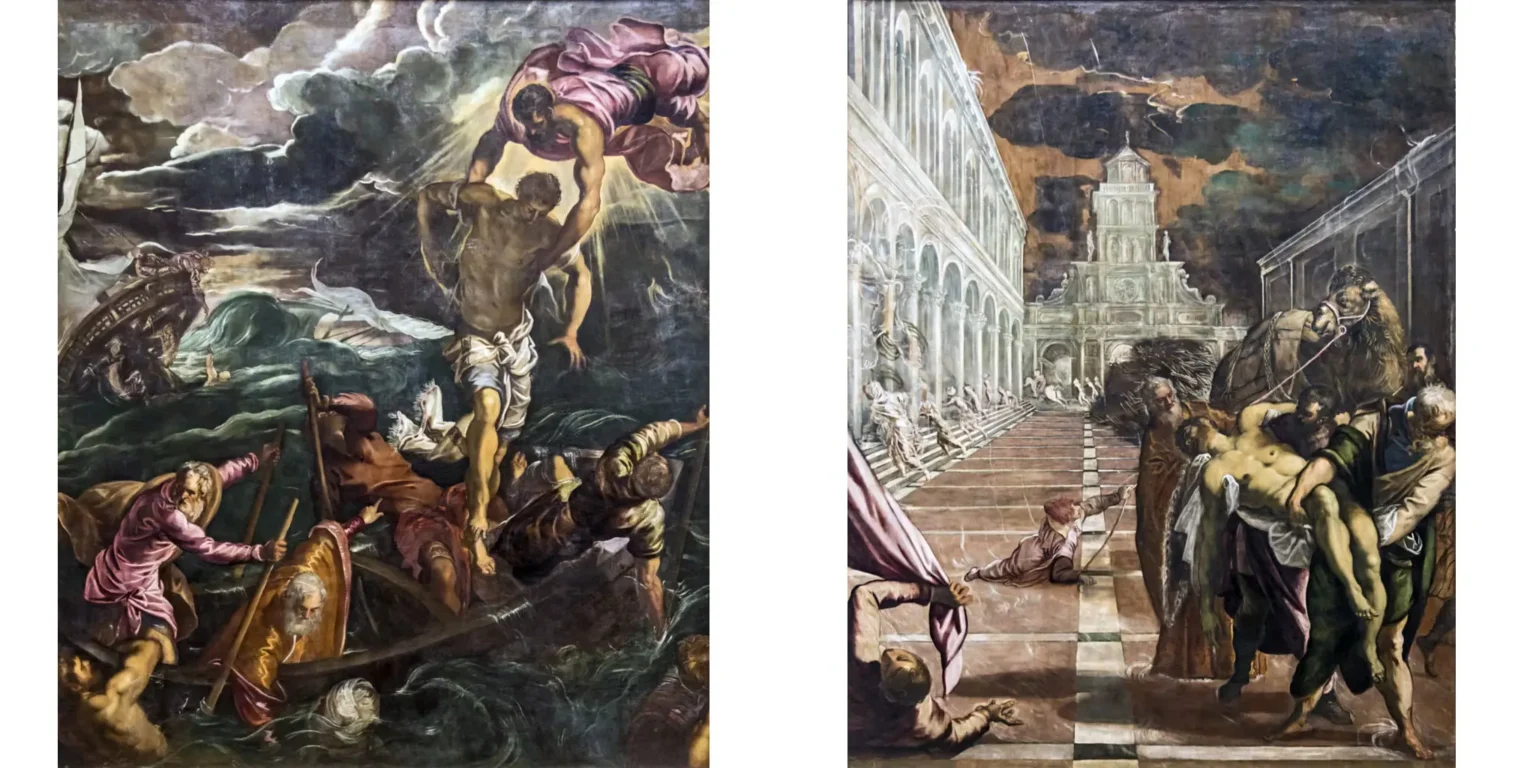
As that last episode illustrates, as Ravenna’s fame and wealth grew, so did his ego.
San Zulian
In the mid-1500s, the medieval church of San Zulian was in a sorry state, and at risk of collapse.
Unusually, the church was a chiesa palatina, i.e., it was under the jurisdiction of the Venetian republic, not the Catholic Church. It was managed by the primicerio of the Basilica di San Marco.
In 1553, Ravenna offered to pay for a new façade for the church, designed by his friend Sansovino, to the price of 1,000 ducats, which was a very substantial amount of money.
The condition of the offer was, that a funerary monument commemorating Ravenna would adorn the front of the church.
The Venetian Senate gave its consent, provided the statue was sitting.
Consequently, the entire façade is a monument to Tommaso Philologus Ravenna. Not just the statue, but every other element, including all the inscriptions present, are about him and him alone.
The façade
The façade is designed by Sansovino, while the bronze statue of Ravenna is by Alessandro Vittoria, a student of Sansovino.
The statue sits on top of a symbolic sarcophagus, surrounded by the symbols of what Ravenna wanted to be remembered for his books, his knowledge, his medicines, his fame.
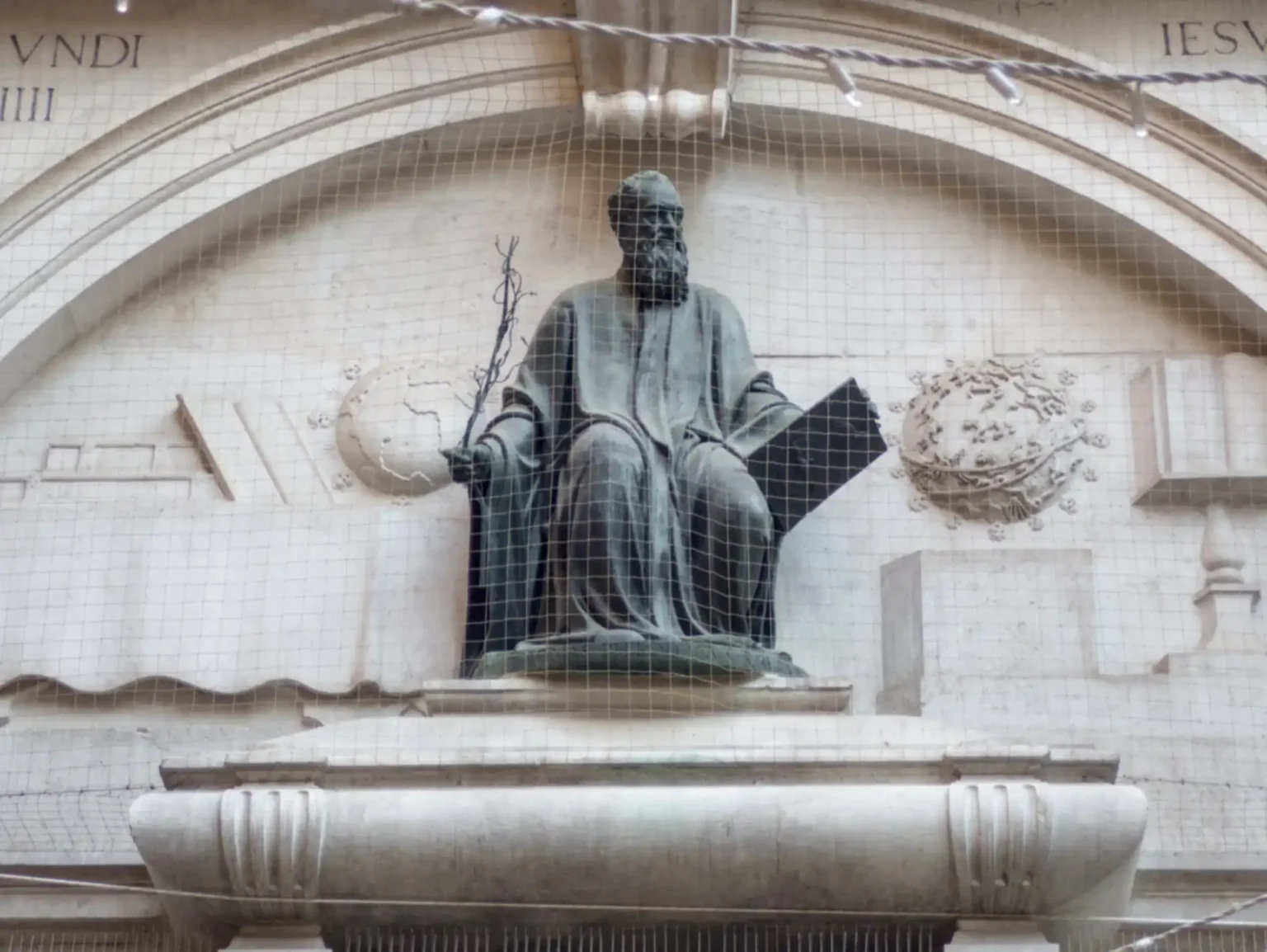
In particular, the branches in his hand are of the plants smilax aspera and lignum vitae, which were both used for medicinal purposes, also against syphilis.
There are several inscriptions on the façade, in Latin, Green and Hebrew, which are all about how accomplished and erudite Tommaso Ravenna was.
The End
Thomas Giannotti Rangoni Ravenna died on September 10th, 1577.
He had survived the plague of 1575–1577, by staying in his home for the entire period.
In his last will and testament, he had made elaborate provisions for his funeral, which would have been grander than the pomp organised for most doges. He was carried through most of the city, in a procession with many of his books on display, and a model of the church.
He was buried inside ‘his’ church of San Zulian.
When, in 1823, it was decided to disinter all the burials inside the church, his bones were taken to the ossuary on the lagoon island of Sant’Ariano, north of Torcello.
His statue, paid for by selling remedies for syphilis, is still there, above the entrance.
The longer article on History Walks Venice on Thomas Philologus Ravennas has the inscriptions transcribed and translated.
Leave a Reply