
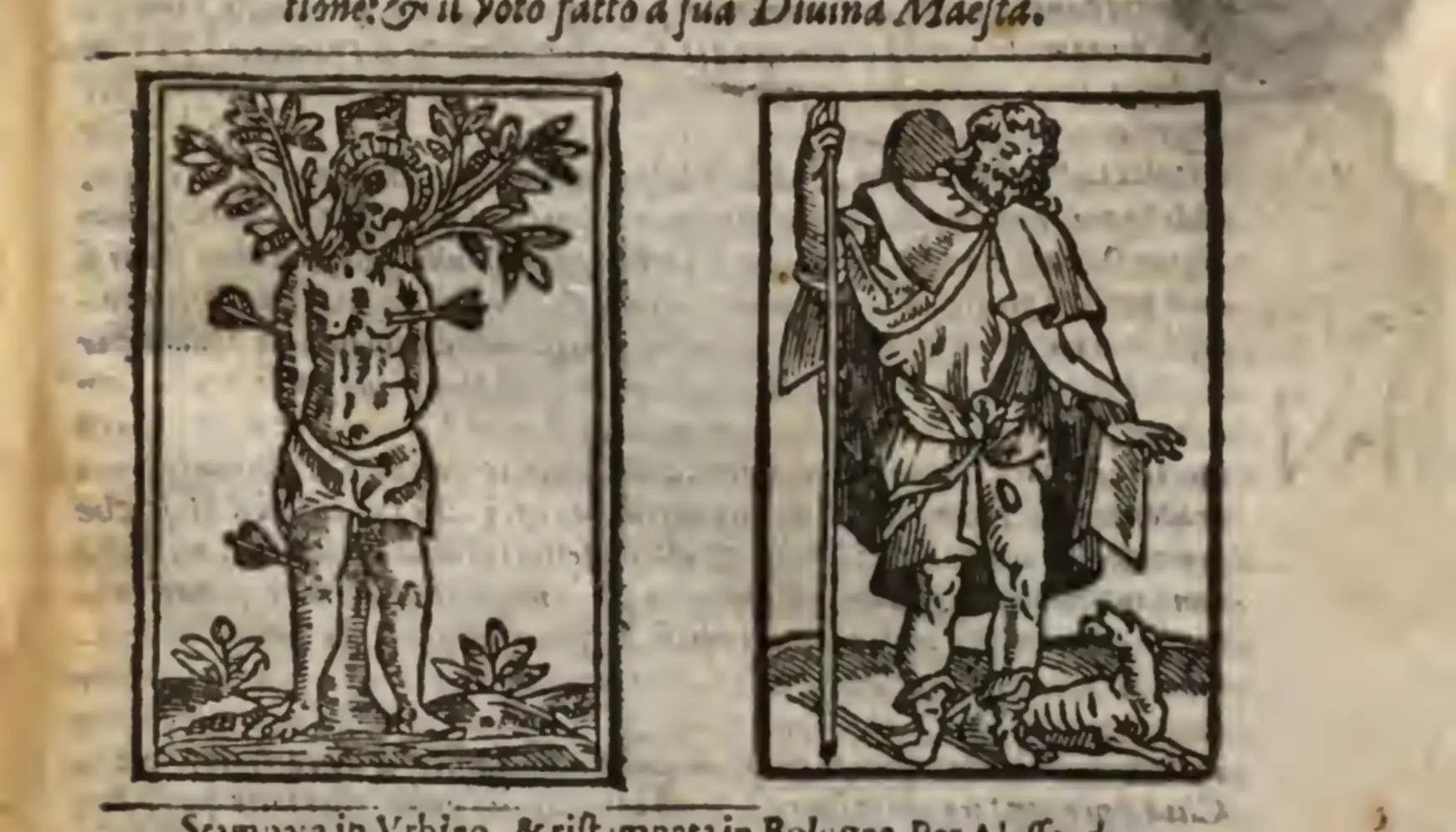
The Redentore Feast, which is held this weekend, commemorates the end of the plague epidemic, which savaged Venice in 1575–77.
In those two disastrous years, between fifty and sixty thousand persons died, in a city with a population of just three times that.
One Venetian in three died of the plague.
It is difficult to fathom a disaster of such dimensions. It is even harder to understand what it did to the people who lived through it.
An eyewitness account of the plague
At the height of the epidemic, the Venetian notary Rocco Benedetti wandered the alleyways of Venice alone.
For long periods, the city was under lockdown, but he was free to move. People were dying, and the services of a notary were needed as never before. He took down last wills and testaments of those who were about to perish.
He also wrote a long letter to a Venetian nobleman, who served as governor of the island of Crete. In it, he described what happened in Venice during the plague.
This letter is a unique eyewitness account of how it was during one of the worst plague epidemics in Venetian history, from a very well-placed observer.
Here are some excerpts from the letter.
The city had become a desolate place:
No more sounds, nor singing, nor other pleasant entertainments could be heard along the streets and canals, but in their place could be heard the continuous crying, sobbing, lamenting, shrieking and howling of tormented persons, some by the evil disease and some by the unhappy death of their loved ones.
and business had effectively ground to a halt:
For me, as a notary, who sometimes happened to go there to make wills, my hair often stood on end, and walking through that solitude I almost felt as if I were dreaming of wandering lost in the silence of the night through deserted and wild places, nor could I sometimes hold back my tears as I considered how such a great city, famous throughout the world for so much business and accustomed to being frequented by an infinite number of people, found itself so deserted and abandoned.
Those who fell ill, and those who had been close to the sick, were taken to the Lazzaretto islands.
But a far more horrible spectacle was the multitude of boats that continually went back and forth, some to Lazaretto Vecchio loaded with the infected and the dead all mixed together, others to Lazaretto Novo loaded with healthy people, others with companies going to the said Lazaretto to carry out the regiment of the forty days of quarantine, towed by other boats.
The corpse collectors (pizzigamorti) were the front line workers, and they were the first to die.
The pizzigamorti became fewer, as there had been a great number of them affected by the plague, and they included not only as many wanderers, vagabonds and other desperate people as could be found in the city, but also as many criminals condemned to the galleys as could be removed from prisons and from the galleys by promising them their release after they had survived serving a certain time.
And because of this lack of pizzigamorti, the infected were often taken to the Lazaretto in the same boat with the dead, and before they arrived there, many of them died of nausea and grief.
Quacks and frauds soon appeared to take advantage of the desperate situation:
Among the first was Antonio Gualtiero, a Flemish merchant, who, offering to liberate the city in eight days, reminded that the healthy should fast at dawn and drink three sips of their own urine, and before dinner eat a little bread in vinegar with rue, and that the infected should likewise drink theirs, both in the morning and in the evening, putting instead a poultice on the bubo, some of their own warm dung, keeping the wound clean with urine until it was healed.
The authorities finally turned to God for redemption:
Whereupon the Prince, together with the Senate, as a sign that he had to obtain forgiveness from the eternal Father, decided to erect a temple for Christ our Lord and Redeemer which would be called the Redentore, for which ten thousand ducats of the public money would be spent, and which would be made simply of brick so that it would be finished all the more quickly.
That was the pledge to build the Redentore church on the Giudecca, taken as the epidemic was waning in early 1577.
The church was finally inaugurated on the third Sunday of July 1577, which is still the date of the Redentore Feast today.
Read the whole thing
I have translated the entire letter from the original Venetian, of which the quotes above are just short excerpts.
Since times have changed, and not everything in the letter is obvious to the modern reader, I have also added explanatory footnotes and appendices.
The letter — with introduction, notes and appendices — can be downloaded as an e-book in various formats from the website History of Venice.
- Read online.
- Download PDF.
- Download EPUB3 (for e-book readers).
The Redentore Feast this year is the 450th anniversary of one of the worst summers in Venetian history.
Next year, it will be the same anniversary of the end of the plague and the inauguration of the church.
This translation is my little contribution to remember all those nameless persons who died and suffered here in Venice 450 years ago.
It is published under a Creative Commons licence, so you are very welcome to share and copy it widely.
Bibliography
- Benedetti, Rocco. Noui auisi di Venetia, ne quali si contengono tutti i casi miserabili, che in quella, al tempo della peste sono occorsi …. In Urbino appresso Battista de Bartoli Vinitiano, 1577. [more] 🔗
- Benedetti, Rocco and Donatella Calabi. Venezia 1576, la peste : una drammatica cronaca del Cinquecento. Venezia Progetto Rialto, 2021. 🔗
- Benedetti, Rocco, Donatella Calabi, Elena Svalduz, Luca Molà and Simone Rauch. Venezia 1576, la peste : una drammatica cronaca del Cinquecento. Venezia Progetto Rialto, 2021. 🔗
Leave a Reply