


After the epidemic of 1630, the Venetians had little choice but to keep their guards up and stay alert. Their only defence was prevention. The plague was still be endemic in Europe for another century and a half, and Venice wasn’t immune. A city can only lose 40% of its population, so often.
Images
Links
- Episode 17 — Venice and the plague – part 1
- Episode 18 — Venice and the plague – part 2
- Episode 19 — Venice and the plague – part 3
- Episode 21 — The Plague Doctor
History Walks Venice
- Capitoli Da osservarsi nelli Lazaretti — 1674
- Poveglia – more than ghost stories
- Ne Fodias – Do not disturb!
Bibliography
- Busato, Davide and Paola Sfameni. Poveglia : l’isola alle origini di Venezia. 2018.
- Magistrato alla Sanità. Capitoli Da osservarsi nelli Lazaretti Stabiliti, e decretati Dagl’Illustrissimi, & Eccellentissimi Signori Sopraproveditori, Aggionti, e Proveditori alla Sanità. Venezia, 1674.
Transcript
Two huge bloodlettings, separated by only two generations, had left Venice reeling.
It probably left countless Venetians reeling too. Memories of such traumatic events tend to last very long, often for generations.
Just consider how long a shadow the second world war has cast. Events of such a magnitude are rarely relegated to the history books while survivors are still alive.
Add to that trauma several costly wars with the Turks over Crete and other territories in Greece, and the diminishing importance of trade on the Levant.
Yet, following the 1630 epidemic, the republic pledged yet another large church to redeem themselves.
This is the massive baroque Basilica di Santa Maria di Salute — Our Lady of Health — at the end of the Grand Canal.
Like the Redentore, it was built by the greatest architects of the time, and cost a fortune. There are supposedly 1.1 million tree trunks in the mud under that church.
Every year, on November 21st, most Venetians still go there to light a candle.
Plague in Rome and Naples, 1656
It wasn’t like the Venetians had any reason to believe they would get a break.
Just one generation later, in 1656, the plague struck again, this time with devastating effect in Rome and Naples.
Other outbreaks followed around Europe, like 1660 in London.
The news of such epidemics spread quickly across Europe, even more so because people were generally very frightened, and, as we have seen in the past episodes, justly so.
Even those who had no direct memory of 1630 had heard all the horror stories from the elders, so they had fairly clear ideas of what would happen if the plague came back.
The Magistrato alla Sanità reacted promptly to the outbreak in Rome and Naples in 1656, by issuing a compilation of past decrees and resolutions, which hadn’t been disseminated sufficiently before, to make sure everybody within the magistracy knew what to do.
In times past, repeated resolutions have been established by the Most Excellent Senate and by this Magistracy of Health, which prescribe the proper forms for performing cleansing and quarantining, with appropriate orders for the avoidance of confusion in the Lazaretti, and a wage appropriate to their employment has been assigned to the Priors and others who serve in them, but since these resolutions are scattered among the Capitulary and Notaries of the Magistracy, and therefore largely unknown to those who are supposed to carry them out, many abuses and disorders have been introduced, which need to be eliminated completely for the greater safety of Health.
The booklet, originally compiled in 1656 under the shadow of the plague in Rome and Naples, was reprinted repeated — at least in 1674, 1719 and 1743 — and a copy given to each prior (manager) of a lazzaretto, so they, if they broke the rules, couldn’t claim ignorance.
The above-mentioned Orders, so that in the future they are not transgressed in any way, should be registered in the Capitulary of the Magistracy, and made to be printed in a booklet, to be delivered by the Notary of the Office to the Priors, who will be in charge at the time, so that without excuse of ignorance they must inviolably and punctually execute them, for which the Notary must have a receipt made by each one so that the delivery made in fulfilment of his obligation always appears.
In slightly less bureaucratese, this boils down to: No excuses!
Marseilles 1720
An epidemic, as bad as the 1575 and 1630 outbreaks in Venice, struck Marseilles in 1720. It killed around forty thousand in Marseilles alone, and some eighty thousands in all of Provence.
With such news from abroad, the Venetians didn’t lower their defences, and the magistrato and the lazzaretti continued to operate as before.
They were expensive and time-consuming for the state, for business, and indeed for everybody, but there was no alternative.
The knowledge that it only took one person to unleash a disaster meant they couldn’t slack.
Decline of the plague
However, during the first half of the 1700s, the numbers of people in the lazzaretti diminished constantly, and by the mid-1700s, the two islands, each with a capacity of hundreds, were running with dozens of persons, rather than hundreds.
The reasons for the decline of the plague in Europe is not entirely clear.
There are several possible explanations, which are not mutually exclusive, so there might very well be more than one valid reason.
The main means of spreading of the plague was through fleas and mosquitoes, which carried the infection from one individual to another, animal or human.
One way the bacterium persisted between outbreaks, was that it found refuge in populations of rodents, in particular rats. Many rodents can live with yersinia pestis in their bloodstream, without getting sick.
The rats in the cities and in the ships didn’t spread the disease directly, but they served as a reservoir where the plague bacterium could linger.
The black Mediterranean rat was very common, and could live with the bacterium.
In the 1700s, shipping in the Atlantic brought the grey Norwegian rat into the Mediterranean. It is an aggressive beast, which doesn’t tolerate rats from other species in its habitat. It will straight out attack and kill black rats, if they live in the same space.
It therefore slowly replaced the black rat in much of the Mediterranean, starting in the western half.
There is, however, an important difference between the two species of rats. In contrast to the black rat, the grey rat dies of the plague.
This could have been a factor in the decline of the plague in the 1700s.
While the population of black rats formed a stable reservoir for yersinia pestis, the grey rat population didn’t. An infected black rat could do a month-long journey from one end of the Mediterranean to the other, carrying the bacterium in its blood. An infected grey rat would be dead in a week, and no longer serve as a vehicle for the contagion.
Another factor could be the stringent isolation of the sick and quarantining of the suspect, which, following Venice’s lead, became the norm in Europe in the 1600s and 1700s.
Isolation and quarantining limited the spread of the disease, making it harder for the bacterium to find new victims to infect and kill.
Finally, genetic factors might have had a role.
Some people appear more likely than others to get the infection, and the repeated epidemics would have given an evolutionary advantage to those who were genetically less susceptible. At some point, they would make up the larger part of the population, and the plague would have a harder time spreading.
This might also explain why the plague is no longer present in Europe, while it still exists in other parts of the world. The Europeans of today are the descendants of those who made it through three centuries of plague epidemics, effectively cleansing the gene pool of those more likely to develop the disease.
Genetic factors could also have played a role on the side of the bacterium. Yersinia pestis would undergo mutations too, and less virulent strains might have come to dominate in the 1700s.
None of these possibilities are mutually exclusive. They might all have played a role in the decline of the plague in Europe in the 1700s.
But, whatever the reasons, the numbers were falling and the cases ever rarer.
Consequently, over time, the number of inmates of the Venetian lazzaretti declined too.
With the administration and bureaucracy around the lazzaretti, this consistent drop didn’t escape the magistrato, which, as always in the Republic of Venice, had to justify all their expenses.
At the same time, in the mid-1700s, the two lazzaretti had been operating for some three centuries. Most of the buildings on the two islands were a couple of hundred years old, and many were either not up to the standard expected of the times, or simply in pitiful states.
Therefore, in the face of falling utilisation and rising costs due to the age of the structures, the decision was taken to demolish both lazzaretti and create a new, smaller, and more agile, structure, on the island of Poveglia, in the southern lagoon.
Lazzaretto Nuovissimo — Poveglia
The choice of Poveglia for the third lazzaretto was not by chance.
The northern entrance into the lagoon, at San Nicolò, had been problematic for centuries. The opening was wide, almost 2km, but there was a large sandbank in front of it, which forced the sailing ships to do very complicated manoeuvres to enter the lagoon.
Furthermore, the available channel was not more than four or five metres deep, depending on the tide.
If this was not a major impediment in the 1300s and 1400s, it became one later.
Ships grew larger and larger, and in later centuries it happened regularly that vessels had to unload cannons and other heavy items on barges out at sea, before they could attempt to negotiate the tricky entrance into the lagoon.
Over the centuries, more and more ships opted for the middle entrance to the lagoon at Alberoni, at the southern end of the Lido, some fifteen kilometres south of Venice.
The island of Poveglia is inside the lagoon, two-thirds of the way from Venice to Alberoni.
Poveglia has an intriguing story.
In the Middle Ages, it was the seat of the podestà, who administered the southern lagoon islands on behalf of the Republic of Venice. There were many hundred families living on Poveglia, and the taxes supporting the podestà were fifty percent from Poveglia, thirty from Malamocco and twenty from Pellestrina.
Those quotas probably reflected the relative population sizes and economic weights of the three settlements, Poveglia being the larger.
However, during the War of Chioggia between 1378 and 1381, Poveglia was occupied by troops from Genoa. Fierce naval battles were fought in the lagoon north of Poveglia, clearly visible from the Doge’s Palace in Venice.
When the Genovese troops were forced to retreat from the island, they destroyed everything, except the churches.
The former residents of Poveglia, who were mostly displaced by the war, were never allowed to return, and were instead settled in Venice, around the parish of Sant’Agnese in Dorsoduro, where the plague of 1630 started.
Poveglia remained under the management of the Venetian navy after 1381, in part as a detachment of the Arsenale, for emergency repairs of ships arriving from the south; in part as a control post on the approach from Alberoni towards Venice; and in part as an element of the fortifications built around the lagoon to protect Venice from attacks from the sea.
Just like the Lazzaretto Nuovo was partly chosen because of its geographical location, so was Poveglia. It sat in the right spot to stop ships approaching Venice from the south, and it was already under the control of the republic.
The structures established on the Lazzaretto Nuovissimo, as the island was now called, were nothing like the two older lazzaretti.
Firstly, due to the dwindling numbers of ships and persons to quarantine, such structures weren’t needed.
The island already had a large open building, which was mostly used as a shipyard, and it was suitable for cleansing goods too.
Otherwise, quarantine happened directly on the ships, which were kept at anchor around the island.
This was not a novelty.
For example, the island of Corfu never really had a lazzaretto as a permanent structure, even if it was a vital harbour and naval base for the Venetian Republic.
Corfu had an isolation harbour.
A bay near the normal harbour area, where suspect ships were kept, was called the porto di contumazia — the isolation harbour.
This much cheaper concept was also employed at Poveglia.
The main reason was that they simply didn’t have the number any more, to sustain more permanent, and more expensive, structures.
The cemeteries on the two old lazzaretti have been excavated, at least partially, and in both cases the estimates are of around five thousand burials on each island.
During the major outbreaks of the plague in Venice, like in 1575 and 1630, innumerable corpses simply went into pits in the mud, or were burned. Those persons were not buried in the excavated cemeteries, which explains the rather modest numbers.
In comparison, on the Lazzaretto Nuovissimo, where we have much better records, over the few decades it was operational, 18 persons died on the island of the plague.
Of these, twelve died in a single episode, which would be the last plague scare during the Republic of Venice.
The 1793 episode
On June 5th, 1793, a tartana arrived in the lagoon.
A tartana was a small sailing ship, with a single mast and a lateen sail and sometimes a bowsprit. They were used from the Middle Ages until the advent of motorised boats, for fishing and coastal trade in the Adriatic and wider Mediterranean.
This ship, under Ottoman flag but named San Nicolò (which is St Nicholas, patron saint of sailors), arrived from Nauplia on the Peloponnese. Nauplia was in the Ottoman Empire, but had been Venetian a century earlier. It had a crew of thirty men and carried a cargo of some nine thousand salted cheeses.
For some reason, it was stopped by the ministers of the Magistrato alla Sanità at Poveglia. Clearly, there was some reason for suspicion.
The Venetian merchant, who had bought the cheeses, apparently feared his goods would go bad, if quarantined for weeks or months by the magistrato.
Consequently, he sent several smaller boats down the following day, and the crew of the San Nicolò and the rowers transferred the many cheeses, using planks as chutes. They finished in the late evening, when the rowed boats returned to Venice with the goods.
On June 8th, workers at Poveglia discovered that some of the crew of the San Nicolò were sick, when on approach they were met with shouts of not coming closer.
The Magistrato alla Sanità immediately closed the harbour entrance at Alberoni, and ordered all ships at anchor around Poveglia to move away from the tartana.
Armed guards were stationed day and night in boats around the San Nicolò, to make sure nobody tried to disembark.
All the workers on the island, who were not considered indispensable, were evacuated.
Then some of the workers, who had been sent to unload the cheeses, fell sick in Venice. They were all rounded up, sent back to Poveglia, where three sheds were constructed: one for the sick, one for the suspect, and one for the guardians.
The emergency continued all through July, August and September, managed by the Magistrato alla Sanità, under the watchful eye of the Venetian Senate.
This was a crisis managed at the highest levels of government, which was only officially called off on October 15th, with solemn masses, ringing of church bells, and the firing of cannons, to celebrate that Venice had avoided another 1575 or 1630.
What this episode tells us — besides the curiosity of it being the last such emergency in the time of the Republic of Venice — is that all the guards were still up.
It was over a century and a half since the last disaster in Venice, the 1630 epidemic, and more than seventy years had passed since the latest such calamity in Europe, the epidemic in Marseilles and Provence in 1720.
Not only were the Venetians still alert, but the organisation was still there, active and functional, rather than hollowed out by continuous budget cuts, as would probably have been the case today.
The end of the lazzaretti
When the Republic of Venice ended in May 1797, it wasn’t just a political change.
The entire state, in all its aspects, vanished. The legal system, the administrative system, everything disappeared with the abdication of the political class of the old republic.
This meant that the Magistrato alla Sanità vanished, and the organisation of the lazzaretti ended.
Four different successor states to the Republic of Venice followed each other over the next two decades, until, in 1815, Venice became part of a newly formed Kingdom of Lombardia-Venetia, ruled by the Habsburg dynasty of Austria-Hungary.
As Europe recovered and reorganised itself after almost a quarter of a century of warfare, the plague was no longer a primary concern. Cases were far in-between, which didn’t warrant permanent structures and expenses.
The story of the plague in Venice therefore ends here.
The plague was mostly gone, and the republic with its magistracies and organisation had entirely disappeared.
The major emergencies of public health in the 1800s were typhus and cholera. They spread through faecal matter polluting the water supply in overpopulated cities, so the solutions needed were very different from what the defence against the plague had required.
Typhus and cholera were fought building sewers and improving the water supply of cities. In Venice, this led to the rain water cisterns being replaced with cast iron fountains with running water from an aqueduct from the Dolomites.
The places and buildings
The physical context of this story of the plague in Venice is still partially there, a bit like a battlefield is still there, after the war is over.
So, what happened to these places, and where are they today?
The Magistrato alla Sanità
The offices of the Magistrato alla Sanità were in a large building close to San Marco, overlooking the harbour.
The harbour of Venice was the basin between the Palazzo Ducale, the Dogana (customs house) and the island of San Giorgio Maggiore.
This building was therefore at the centre of power of the Republic of Venice, a part of the governmental complex of buildings around the Piazza San Marco, even if it didn’t face the square.
During the Napoleonic period in Venice, from 1805 to 1815, the building was razed to the ground, and replaced with a garden, connected to the new royal apartments in the Procuratie.
This garden, still called the giardino reale — the Royal Garden — is there today, but it is mostly a place where tourists sit on benches to rest their feet, or to eat a packed sandwich.
Not a stone of the old Magistrato alla Sanità has survived.
Lazzaretto Vecchio
The island of Lazzaretto Vecchio was already decommissioned when the republic ended, but little had been demolished.
As all property of the Republic of Venice passed from successor state to successor state, so did the Lazzaretto Vecchio.
In practice, it became military, as did most lagoon islands. It was occupied, first by the Austrian military, then by the Italian army.
The Medieval church was soon demolished, having no military purpose, leaving a solitary bell tower, until that was removed too. A photograph of the bell tower exists.
Some other buildings were taken down, but most were kept, but come to us in a more or less molested state.
The Italian army left the island around 1970, and it was handed over to a group of volunteers, which saved stray dogs to get them adopted. In practise, the island became an open-air kennel for stray dogs.
Many of the locals on the nearby Lido di Venezia know the island as “dog island”, due to the constant barking. The kennel was there for some thirty to forty years, dogs roaming freely in and around the abandoned buildings of the lazzaretto.
From a cultural and historical perspective, such a dog kennel is still abandonment. The place was not cared for, despite its historical and cultural importance as the first stable lazzaretto in world history.
Starting around 2008, the Italian ministry for cultural heritage drew up a plan for the recovery of the island, which is proceeding slowly. The plan includes a National Archaeological Museum on the island, so it won’t be a museum for the Lazzaretto Vecchio, but a museum on the Lazzaretto Vecchio.
The kennel of stray dogs was evicted, and preliminary work to at least stabilise the surviving buildings soon started.
Volunteers from the Lazzaretto Nuovo — we’ll come to that island in a second — went as guardians and organised occasional open weekends for the public.
Currently, the island is a building site, as the works to make what remains of the buildings suitable for a modern museum. It is therefore not possible to go there.
Lazzaretto Nuovo
The Lazzaretto Nuovo island had a similar destiny. It became military, and the Austrian army turned it into a munitions depot associated with a large gun position on the neighbouring island of Sant’Erasmo.
They made sweeping changes to the island, and demolished almost all the ancient buildings.
The main surviving building is a large warehouse from the 1560s, which was used for cleansing the goods of suspect merchant ships. The inside walls of this building have some very interesting writings and drawings, made by the workers on the island, mostly from the late 1500s.
The only other surviving buildings are two gunpowder towers from the late 1500s, which weren’t, strictly speaking, part of the lazzaretto.
This island remained military until 1975, when the Italian army finally abandoned it, in, to say it mildly, a pitiful state.
Everything was totally overgrown, basically a jungle, and the roofs of many buildings caved in, as the island hadn’t really served any military purpose since World War II.
Here too, the island was picked up by a group of volunteers, but in a much more constructive way than on the Lazzaretto Vecchio.
On the Lazzaretto Nuovo, the volunteers formed a formal association, which obtained a legal concession on the island. They started clearing out the vegetation, repairing what they could, and obtaining funding from the Veneto region and from the European Union, to recover and restore the buildings.
Collaboration with national archaeological associations, and with Italian and foreign universities, has led to proper archaeological digs of several parts of the island, and restoration of the writings and drawings in the main building.
All this had led to a great many publications, both popular and scientific, not to speak of post-graduate and doctoral theses.
The island is now open to visits, as the volunteer association has created a museum and organises regular guided visits to the island.
The salvaging of the Lazzaretto Nuovo is the best example of the recovery of an abandoned island in the Venetian lagoon.
Citizens picked up a ball, which the Italian state had not only dropped, but totally discarded, and they have created one of the brightest jewels in the entire lagoon area.
If you ever come to Venice, do go and visit the Lazzaretto Nuovo. We might even meet in person, as I am one of the several guides working there part-time.
Lazzaretto Nuovissimo
The island of Poveglia — the Lazzaretto Nuovissimo — continued to function as a quarantine station during the French and Austrian periods, not so much for the plague, but for whatever contagious diseases appeared.
After 1866, with the annexation of Venice to the Kingdom of Italy, the island became a generic “Marine Sanitary Station” for the Italian navy, for whatever contagious diseases appeared on navy ships.
Those buildings, and others constructed later, then became a public hospital for respiratory and skin diseases — mostly tuberculosis and psoriasis — for most of the 1900s.
Various kinds of baths were a central part of the cures for both ailments.
Around Christmas 1969, the water supply of the island got polluted with salt water, and all the patients were evacuated to other hospitals until the problem was solved. You can’t really run a hospital without clean water, especially not one, where bathing is central to the cures offered.
The problem, however, wasn’t solved.
The hospital never reopened, and the island has been abandoned ever since.
One can see that some attempts were made to pack up beds and other objects, but then the piles just remained there.
Vandals have savaged the place over the last fifty years, and the once pleasant gardens are now overgrown and impenetrable. Roofs and upper storey floors have collapsed, leaving the whole place as a ruined mess — albeit a very photogenic ruined mess.
Consequently, the island has become popular with Urban Exploration photographers.
It has also, unfortunately, become popular with ghost hunters.
This is such an immense stupidity, and I seriously doubt anybody really believes it, but media and online influencers use it for clicks and views.
Earlier in this episode, I talked about that last plague emergency in Venice, in 1793, when twelve persons died on the island.
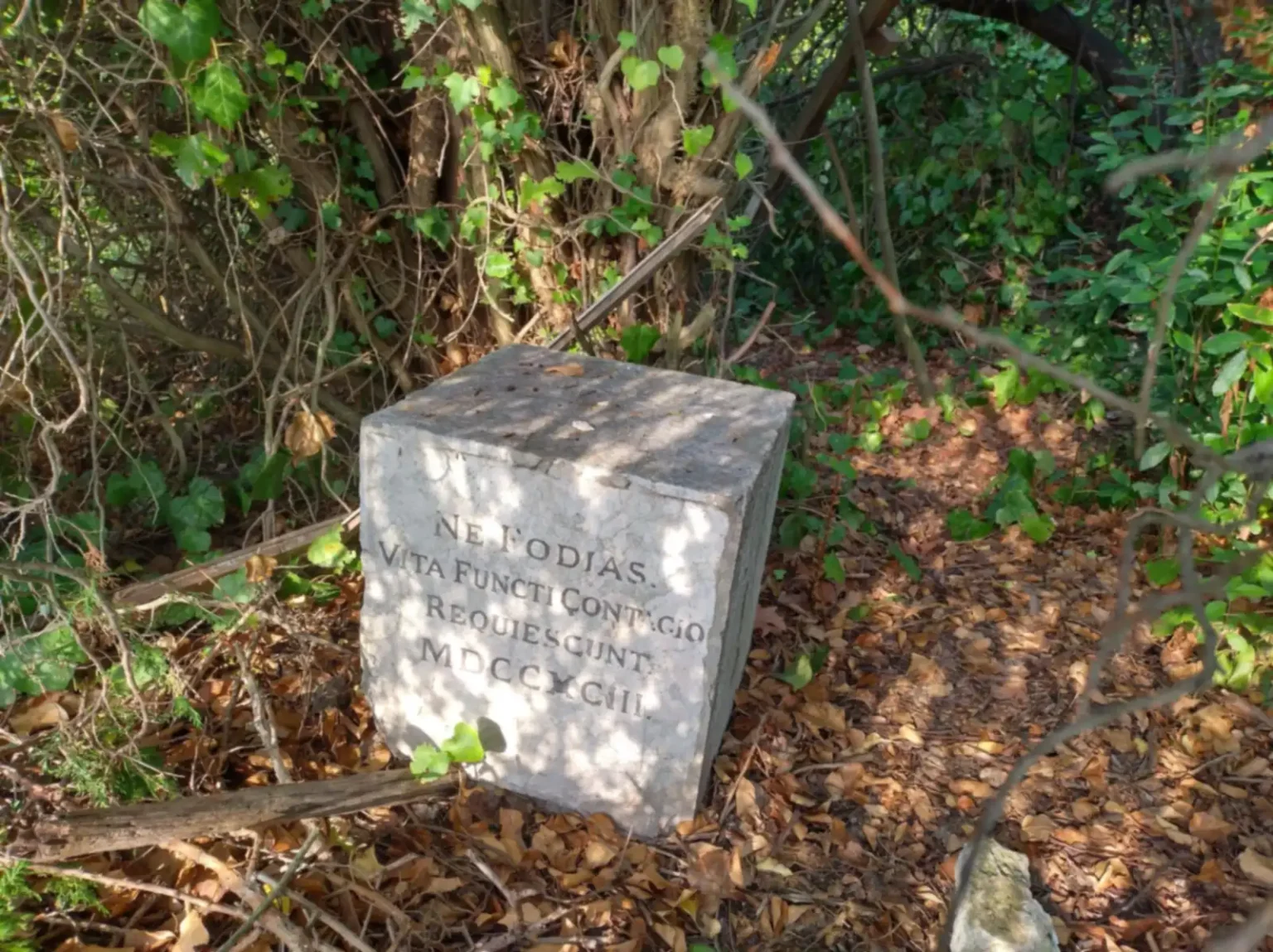
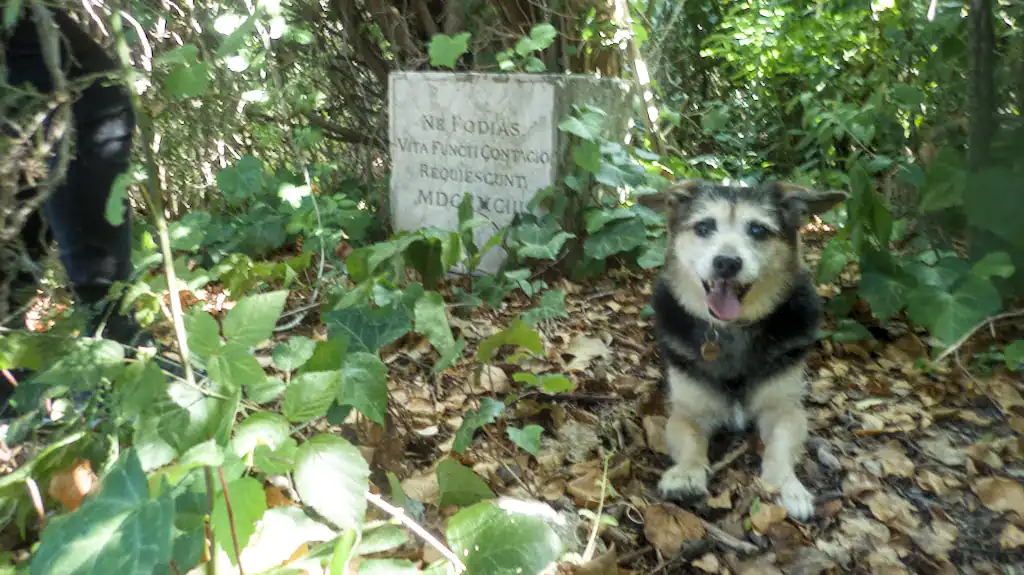
A stone was placed on their burial place, warning people not to dig there. The Latin inscription more or less says:
Do not disturb! Those who in life were contagious, rest here. 1793.
This stone, hidden under the brambles, caught somebody’s attention, probably in the mid-1990s, and they made up a bunch of stories about the ghosts of the “thousands of plague dead” buried on the island.
Well, those “thousands” were 18, as we have documents, of which twelve in that one episode of 1793. If you want “thousands” of plague victims, you got the wrong island.
Later, others added to the fantasy, and invented a crazy doctor operating on the brains of patients of the hospital, and their souls wandering the island searching for their tormentor.
Of course, being a hospital for tuberculosis and psoriasis, treated with bathing, there were no operating rooms in the hospital, and definitely no crazy brain surgeons.
Honestly, I have little patience for this kind of crap, and still have to answer all the requests I get for going there by night.
I’ve put a photograph of the stone on the web page for this episode, so click through to the website to have a view.
This is all about clicks and views, right?
OK, we’re at the end, and another episode gone too long. I need to get better at shutting up.
Next episode, as I have threatened several times, will be the plague doctor on trial. After that, I think I’ll plague you with something else.
Leave a Reply